Moving is one of those projects that looks manageable on paper.
Rent a truck. Find some boxes. Get a few people together. Load everything. Drive to the new place. Unload.
Easy, right?
Then moving day arrives.
Someone can't find the truck keys.
The movers are waiting while you're still taping boxes.
The phone charger is somewhere inside one of 47 identical cardboard boxes.
Nobody knows which box has the coffee maker.
The kids need something that was loaded first — which means it's now buried at the very front of the truck.
And the one thing you absolutely need tonight?
You know you packed it.
You just have no idea where.
If you're moving over Labor Day weekend, a little planning can save you a tremendous amount of frustration.
Labor Day also comes at the tail end of the traditional summer moving season. Detailed U.S. Census Bureau research into moving patterns found that nearly one-third of moves occurred during June, July and August. More recent Census data shows that 11.8% of Americans changed residences during 2024 — roughly one out of every nine people.
So if your Labor Day weekend includes moving boxes instead of a barbecue, you have plenty of company.
Here's how to make the big moving day go a whole lot better.
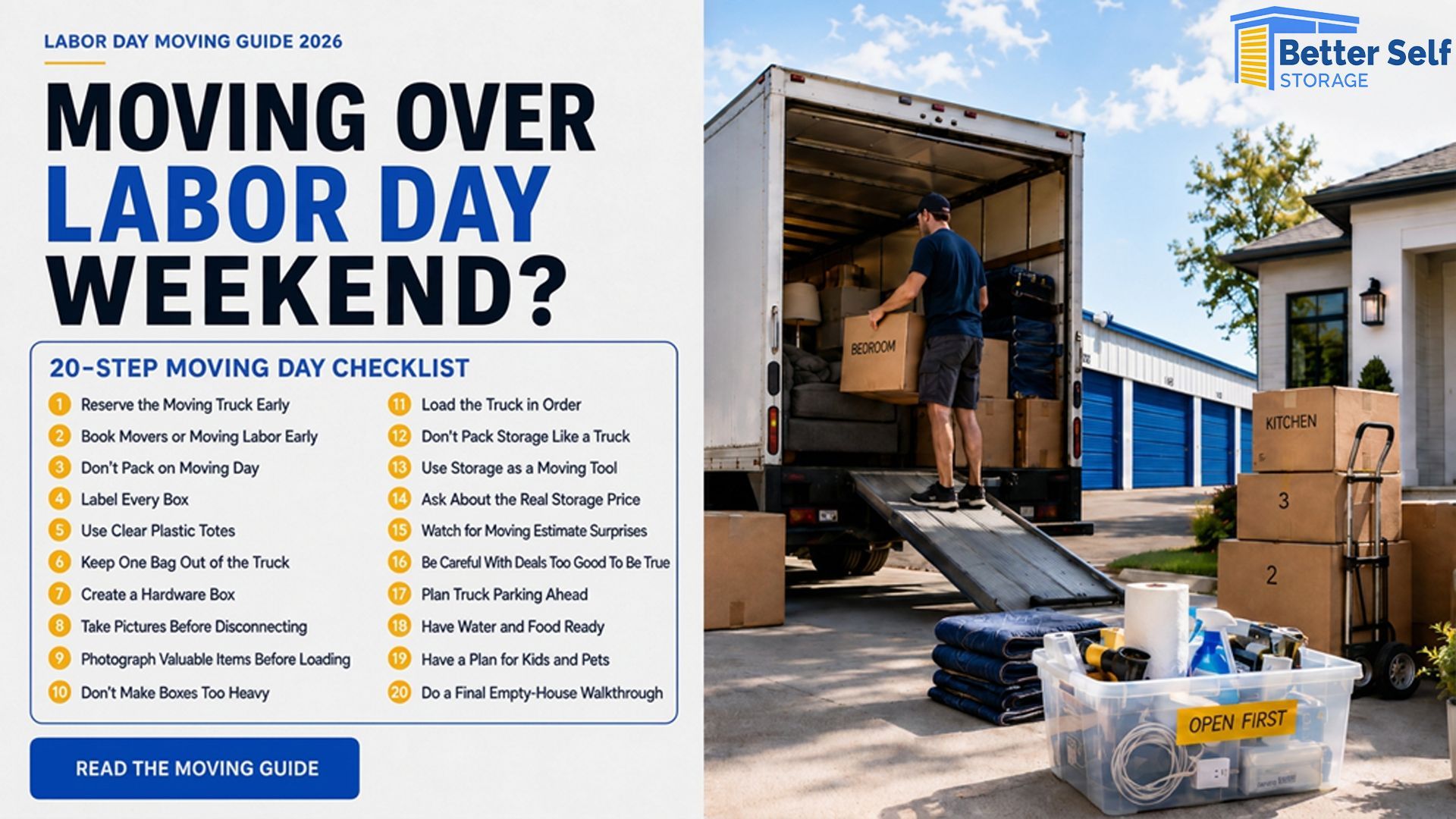
1. Reserve the Moving Truck EARLY
Do not make the moving truck the last thing on your list.
Especially around a holiday weekend.
U-Haul's updated 2026 guidance specifically recommends reserving moving trucks as early as possible during summer and around holiday weekends because availability can become limited. Penske similarly recommends beginning the truck-reservation process at least a month before a move when possible.
If you know you're moving Labor Day weekend, start looking as soon as your moving date is reasonably firm.
And don't just reserve "a truck."
Think about:
- How many bedrooms are you moving?
- Are you moving appliances?
- Do you have oversized furniture?
- How far are you going?
- Will you need a dolly?
- Furniture pads?
- Tie-downs?
- A trailer?
- Extra mileage?
- Another driver?
- More than one day?
A slightly larger truck may cost more upfront, but multiple trips across town — or discovering halfway through loading that everything won't fit — can be much worse.
Confirm your reservation again.
A few days before moving day, verify:
Pickup location
Pickup time
Truck size
Return location
Return deadline
Mileage allowance
Fuel requirements
Equipment you reserved
Take a screenshot of the confirmation.
Moving day is not when you want to discover that the information you thought you had isn't the information in the reservation system.
2. Book Movers — or Moving Labor — Early Too
The truck isn't the only thing that can become difficult to find.
Professional movers, hourly loading crews and local day labor can also fill their schedules during busy weekends.
If you're hiring help, don't assume you'll be able to find three people Saturday morning because you suddenly realize the sectional weighs approximately as much as a small automobile.
Arrange your help early.
If you're hiring a professional moving company, get the agreement in writing and understand exactly what you're paying for.
For an interstate move, the Federal Motor Carrier Safety Administration recommends checking that the mover is registered with FMCSA and obtaining a written estimate. FMCSA also warns consumers about movers who demand large upfront cash deposits, provide only verbal estimates or ask customers to sign blank documents.
If you're hiring hourly moving help or day labor, ask:
- What time will they arrive?
- How many people are coming?
- Is there an hourly minimum?
- What happens if the job takes longer?
- Are stairs included?
- Are unusually heavy items included?
- Who provides dollies and moving equipment?
- Will they load the truck, unload it, or both?
- Are there additional travel charges?
- What happens if someone cancels?
Don't wait until moving morning to figure this out.
3. Moving Day Should NOT Be Packing Day
This one deserves capital letters.
You should not still be packing the house when the moving truck arrives.
Yes, there will probably be a few last-minute items.
That's normal.
But if half the kitchen is still in cabinets when your movers show up, you're already behind.
The Home Depot's moving guidance recommends building extra time into your schedule specifically so you're not packing on moving day.
A much better goal:
48 hours before moving:
95% packed.
Night before:
Almost everything boxed, taped and labeled.
Moving morning:
Bedding, toiletries, refrigerator items and true last-minute necessities.
Your moving crew should spend moving day moving, not standing around while someone searches for another roll of packing tape.
4. Label Every Box — But Don't Just Write "Kitchen"
Here's one of the easiest improvements you can make.
Bad label:
KITCHEN
Better label:
KITCHEN – POTS/PANS – LOWER CABINET
Even better:
KITCHEN – POTS/PANS – LOWER CABINET – OPEN THIS WEEK
We recommend putting three pieces of information on the top AND at least one side of every box:
ROOM
Where does it go?
CONTENTS
What's actually inside?
PRIORITY
When will you need it?
Try:
1 – OPEN FIRST
2 – OPEN THIS WEEK
3 – NO RUSH
Now when you're standing in a room surrounded by 25 boxes, you know exactly where to start.
Home Depot also recommends labeling boxes with both their destination room and contents.
5. Clear Plastic Totes Cost More — But Use a Few Anyway
Cardboard moving boxes are usually the economical choice for most belongings.
We wouldn't suggest buying 50 clear plastic totes just to move.
But buying a handful?
That can be money very well spent.
Why?
You can see what's inside.
That sounds insignificant until you've been in the new house for twelve hours and someone asks:
"Where's the medicine?"
"Where's toilet paper?"
"Where are the dog bowls?"
"Where's the coffee?"
"WHERE IS THE PHONE CHARGER?"
A clear tote lets you identify important belongings without opening five boxes.
Home Depot specifically recommends preparing a clear plastic moving-day bin for items you'll need immediately after loading or before the rest of the house is unpacked.
We would make at least two clear totes.
CLEAR TOTE #1 — FIRST NIGHT
Put in:
- Toilet paper
- Paper towels
- Hand soap
- Basic cleaning supplies
- Trash bags
- Phone chargers
- Extension cord
- Basic tools
- Scissors
- Box cutter
- Tape
- Flashlight
- Paper plates
- Plastic utensils
- Cups
- Coffee supplies
- Snacks
- Pet food and bowls
CLEAR TOTE #2 — IMPORTANT HOUSEHOLD ITEMS
Consider:
- Wi-Fi equipment
- Remotes
- Important cords
- Hardware from disassembled furniture
- Shower curtain
- Towels
- Bedding basics
- Children's must-have items
- Basic kitchen necessities
Put brightly colored tape around these totes.
Write:
DO NOT LOAD FIRST
You want them accessible.
6. Keep One Bag OUT of the Moving Truck
Treat moving day like an overnight trip.
Every person should have a small bag with the things they'd need if the moving truck mysteriously disappeared until tomorrow.
Include:
- Change of clothes
- Pajamas
- Toothbrush
- Toiletries
- Medications
- Phone charger
- Laptop charger
- Children's necessities
- Baby supplies
- Basic pet supplies
And keep certain items with you — not buried in the moving truck.
That may include:
- Wallets
- IDs
- Passports
- Keys
- Important paperwork
- Jewelry
- Medications
- Phones
- Laptops
- Irreplaceable small valuables
The goal is simple:
If the truck doesn't get unloaded tonight, can your family still function?
7. Create a "Hardware Box"
This little trick can save your sanity.
When you take apart:
- Beds
- Tables
- Desks
- Shelving
- TVs
- Furniture
Put the screws, bolts and hardware into individual zip-top bags.
Label each bag:
PRIMARY BED – BED FRAME HARDWARE
Then put ALL those bags into one designated hardware box or tote.
Add:
- Screwdrivers
- Allen wrenches
- Drill
- Drill bits
- Tape measure
- Small hammer
- Pliers
- Utility knife
Now you don't have furniture sitting in pieces for four days because six screws have disappeared into the moving universe.
8. Take Pictures Before You Disconnect Everything
Before unplugging the TV?
Take a picture of the cords.
Before disconnecting the computer?
Picture.
Before disassembling a complicated shelf?
Picture.
Before pulling apart something you haven't assembled since 2017?
Definitely take a picture.
You may think you'll remember.
Moving day has a remarkable ability to erase that confidence.
9. Photograph Valuable or Easily Damaged Items Before Loading
Take quick pictures before things go onto the truck.
Furniture.
Electronics.
Appliances.
Antiques.
Anything with an existing scratch or dent.
If you're using professional movers, FMCSA recommends being present while your household belongings are inventoried and resolving questions about an item's condition before the move.
Photos also create a simple record of what things looked like before transportation.
It takes a few minutes.
Do it.
10. Do Not Make Your Boxes Too Heavy
A giant moving box completely filled with books sounds efficient.
Until someone tries to lift it.
Use smaller boxes for heavy items.
Use larger boxes for lighter things.
Think:
SMALL BOX
Books, canned goods, tools
MEDIUM BOX
Kitchen items, toys, electronics
LARGE BOX
Bedding, pillows, towels, lightweight household items
Your back will thank you.
So will everyone who volunteered to help.
11. Load the Truck in the Order You'll Need Things
Don't just carry things outside and throw them wherever they fit.
Have a plan.
Generally, items you won't need immediately can go deeper into the truck.
Things you need quickly should remain accessible.
And remember:
First into the truck usually means last out.
That matters.
If you need your mattresses tonight, think about where they're loaded.
If you're moving belongings directly into storage, think about that too.
Which brings us to one of the most common storage mistakes.
12. If You're Using Self Storage, Don't Pack the Unit Like a Moving Truck
A moving truck gets completely unloaded.
A storage unit might not.
That's an important difference.
Do not fill a storage unit wall-to-wall with absolutely no way to reach anything in the back.
Leave yourself a walkway whenever possible.
And put items you may need sooner toward the front.
FRONT OF STORAGE UNIT
Things you may need within weeks:
- Seasonal clothes
- Tools
- Business inventory
- Documents
- Children's items
- Frequently used equipment
BACK OF STORAGE UNIT
Things you probably won't touch soon:
- Extra furniture
- Long-term household storage
- Archive boxes
- Seasonal decorations several months away
- Items awaiting a future home
And remember those priority numbers?
They're useful here too.
1 = likely needed soon
2 = may need
3 = long-term
Storage isn't very helpful if retrieving one box requires unloading half the unit.
13. Storage Can Be a Moving Tool — Not Just a Place for Extra Stuff
One of the biggest mistakes people make is believing everything has to move from House A directly into House B on the same day.
It doesn't.
Sometimes temporary storage can make a move substantially easier.
Storage can help when:
Your closing dates don't line up.
You have to leave one home before the next is available.
You're downsizing.
You're not ready to decide what stays and what goes.
You're selling a house.
Moving excess furniture and belongings out before listing can make decluttering easier.
You're remodeling the new home.
You'd rather not move furniture into rooms that will immediately be painted or refloored.
You're combining households.
Two houses worth of belongings don't automatically fit neatly into one.
You're moving in stages.
You can move nonessential belongings ahead of the big day rather than trying to move absolutely everything at once.
That's how we think storage should work:
It should solve a problem.
Not create another one.
14. Ask About the REAL Price Before Renting Storage
This matters to us at Better Self Storage.
Don't shop based only on the giant promotional number in an advertisement.
Ask:
- What's the monthly rent?
- Are there administrative fees?
- Are there mandatory add-ons?
- What coverage requirements apply?
- Is a lock included?
- How long does the promotional rate last?
- Is the rental month-to-month?
- What are the access hours?
- When could the rental rate change?
- How much notice is required before move-out?
A slightly cheaper advertised rate isn't necessarily cheaper after everything is added.
Know what you're agreeing to before you rent.
That's true for storage.
It's true for moving trucks.
And it's definitely true for movers.
15. Watch for Moving Estimate Surprises
Moving costs sometimes change because the job itself changes.
Maybe there are stairs.
Maybe the truck has to park farther away than expected.
Maybe there are more belongings than originally disclosed.
Maybe an elevator or parking permit is required.
FMCSA notes that extra services or circumstances such as stairs, elevators or parking requirements can affect an interstate moving estimate.
That is why you should tell your moving company about those details BEFORE moving day.
Ask specifically about:
- Stairs
- Elevators
- Long carries
- Parking
- Heavy furniture
- Pianos
- Safes
- Appliances
- Extra stops
- Storage stops
- Waiting time
- Packing services
You don't want your first conversation about those charges happening while everything you own is sitting on a truck.
16. Be Careful With a Moving Deal That Seems WAY Too Good
Moving fraud is real.
For interstate moves, FMCSA identifies several warning signs worth knowing.
Be cautious if a company:
- Refuses to provide a written estimate
- Demands a large cash deposit before moving
- Doesn't provide registration information
- Has no physical business location listed
- Gives a suspiciously low estimate without properly assessing what you're moving
- Asks you to sign blank paperwork
FMCSA recommends verifying interstate movers through its registration database before hiring them.
Saving money is good.
Turning everything you own over to a company you haven't checked out isn't.
17. Think About Parking BEFORE the Truck Arrives
Can the moving truck actually get close to the door?
That question gets overlooked surprisingly often.
Check:
- Apartment parking rules
- HOA restrictions
- Loading zones
- Street parking
- Gates
- Low-clearance areas
- Tree branches
- Narrow driveways
- Alleys
- Elevator reservations
If you're moving into an apartment or condo, ask whether you need to reserve the loading area or elevator.
Do this BEFORE Labor Day weekend.
The office may be closed when you suddenly need permission.
18. Don't Forget About Water, Food and the People Helping You
Moving day is physical work.
Have water available before anyone arrives.
Not buried inside a refrigerator that's already wrapped in moving blankets.
Set aside:
- Bottled water
- Sports drinks
- Easy snacks
- Sandwiches
- Fruit
- Paper towels
- Trash bags
If friends are spending six hours helping you carry furniture because you promised pizza?
Buy the good pizza.
They earned it.
19. Have a Plan for Kids and Pets
Small children plus open doors plus moving crews plus hand trucks plus heavy furniture can become chaotic quickly.
Pets can also become stressed or slip out through doors that are repeatedly being left open.
If possible, arrange for children or pets to spend the busiest part of moving day with someone you trust.
If that isn't possible, designate one room as the calm zone and make sure everyone involved in the move knows it.
Moving day already has enough variables.
20. Do One Final EMPTY-HOUSE WALKTHROUGH
Don't rely on memory.
Walk every room.
Actually open things.
Check:
- Closets
- Cabinets
- Drawers
- Dishwasher
- Refrigerator
- Freezer
- Oven
- Garage cabinets
- Attic
- Basement
- Shed
- Patio
- Behind doors
- Medicine cabinets
- Washer and dryer
- Crawl spaces
- Outdoor storage
FMCSA's official moving checklist also recommends making one final inspection before the moving van leaves to make sure nothing was forgotten.
Take photos of the empty rooms while you're there.
Then lock up.
The Better Self Storage Big Moving Day Checklist
4+ WEEKS BEFORE
☐ Reserve moving truck
☐ Get moving-company estimates
☐ Reserve professional movers or moving labor
☐ Reserve storage if needed
☐ Start donating or selling unwanted items
☐ Order boxes and packing supplies
☐ Confirm closing or lease dates
☐ Check moving-truck parking requirements
2–3 WEEKS BEFORE
☐ Start packing nonessential belongings
☐ Label boxes by room, contents and priority
☐ Transfer utilities
☐ Submit change-of-address information
☐ Confirm elevator/loading reservations
☐ Arrange child or pet care
☐ Confirm movers
☐ Confirm storage unit
1 WEEK BEFORE
☐ Confirm truck reservation
☐ Confirm moving labor
☐ Finish most packing
☐ Prepare clear moving-day totes
☐ Prepare overnight bags
☐ Photograph valuable items
☐ Create hardware box
☐ Organize important paperwork
NIGHT BEFORE
☐ Charge phones
☐ Charge portable batteries
☐ Put keys together
☐ Refrigerate drinks
☐ Put important documents somewhere that will NOT go on the truck
☐ Finish packing
☐ Set aside cleaning supplies
☐ Confirm addresses with everyone helping
☐ Go to bed at a reasonable hour
Yes.
Really.
MOVING MORNING
☐ Keep medications and important belongings with you
☐ Keep first-night totes accessible
☐ Walk through loading plan
☐ Take pictures if needed
☐ Supervise loading
☐ Keep walkways clear
☐ Check every room before leaving
☐ Confirm destination address with driver
AT THE NEW HOME
☐ Direct boxes to the correct rooms immediately
☐ Unload OPEN FIRST boxes where they'll be used
☐ Assemble beds early
☐ Get the bathroom functional
☐ Get children's and pet necessities set up
☐ Locate the coffee
This last step may be the most important.
One More Moving Tip: You Don't Have to Finish Everything Today
This might be the most useful advice in this entire guide.
Moving day doesn't have to end with every box unpacked.
Get the essentials working:
A place to sleep.
A functioning bathroom.
Medicine.
Food.
Kids settled.
Pets settled.
Phones charging.
Coffee available for tomorrow morning.
The rest can wait.
Moving is already a major transition.
Don't turn the first night in your new home into an endurance contest.
When Storage Makes Moving Easier
Better Self Storage started from the perspective of storage customers ourselves.
More than 35 years of experience in real estate and self storage has taught our family something pretty simple:
People usually don't rent storage because they woke up excited to rent a storage unit.
They're moving.
They're downsizing.
They're remodeling.
They're combining households.
They're helping a parent.
They're dealing with an unexpected transition.
Or they simply need more room.
That's why our goal is to make the storage part as straightforward as possible.
Better Self Storage offers locations serving communities in Utah, Idaho, Wyoming, Kansas, Arkansas and Washington, with flexible month-to-month rentals and storage options for household, business and moving needs.
And because moves do not always go according to schedule, our 24/7 live property management team is available when you need rental help or have storage questions. Online rentals are available anytime as well.
No chatbot pretending to be your property manager.
Real people.
Real help.
And one less thing to worry about on moving day.
Frequently Asked Questions About Moving Over Labor Day Weekend
Is Labor Day weekend a busy time to move?
Labor Day falls at the end of the traditional summer moving season. Census Bureau research has historically shown a substantial concentration of U.S. moves during the summer months, and truck-rental companies recommend booking early for summer and holiday-weekend moves.
How early should I reserve a moving truck?
Earlier is better during peak periods. Penske recommends starting the truck-selection process at least a month before moving, while U-Haul advises reserving as early as possible for summer and holiday-weekend moves.
Should I hire moving labor in advance?
Yes. If you plan to use professional movers, hourly loading help or day labor, arrange it in advance rather than depending on same-day availability. Confirm how many workers are coming, their arrival window, minimum hours and exactly what work is included.
What's the best way to label moving boxes?
Label boxes with at least three things: destination room, contents and priority. For example: "KITCHEN – COFFEE/CUPS – OPEN FIRST."
Are clear plastic totes worth using for moving?
They cost more than ordinary cardboard boxes, so you probably don't need them for everything. But a few clear totes can be extremely helpful for important moving-day items because you can identify the contents without unpacking multiple boxes.
Should I rent storage before or after moving?
If you already know you'll need storage, reserving it before moving day can make planning easier. You can move nonessential belongings ahead of time and avoid trying to solve your storage problem while the moving truck is already loaded.
Can self storage help when home closing dates don't match?
Yes. Short-term storage can provide a temporary place for belongings when you need to leave one property before the next home is ready.
Moving This Labor Day?
Reserve the truck.
Reserve your movers or moving labor.
Buy the boxes.
Label everything.
Spend a little extra on a couple of clear totes.
Keep your important belongings with you.
And don't wait until moving morning to figure out the plan.
Your future exhausted self will be very grateful.
If storage is part of that plan, Better Self Storage is here to help with flexible storage options and real people available 24/7 for rental assistance.
Find the Better Self Storage location nearest you and check current unit availability before the big moving day.
Then hopefully you can still find a little time for a Labor Day barbecue.
You've earned it.